
As demand grows for cleaner ingredients and more sustainable manufacturing practices, industries are rethinking how valuable compounds are sourced from nature. Traditional extraction methods rely on organic solvents that leave residues, consume significant energy, and can degrade sensitive compounds during processing. Supercritical Fluid Extraction (SFE) offers a compelling modern alternative, gaining rapid commercial traction.
The global SFE market was valued at USD 2.9 billion in 2024 and is projected to reach USD 7.9 billion by 2034, growing at a CAGR of 10.8%. This growth reflects a clear industry-wide shift toward extraction technologies that deliver both superior product quality and reduced environmental impact.
What Is Supercritical Fluid Extraction?
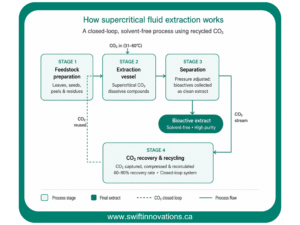
Supercritical Fluid Extraction uses carbon dioxide in its supercritical state to isolate valuable compounds from natural materials. A substance becomes “supercritical” when it is subjected to conditions above its critical temperature and pressure, in CO₂’s case, just 31°C and 73.8 bar, at which point it simultaneously exhibits properties of both a liquid and a gas.
In this state, supercritical CO₂ behaves uniquely:
- Like a gas, it diffuses deeply into plant material with low viscosity.
- Like a liquid, it dissolves and carries target compounds due to its high solvating power.
- Unlike either, its properties can be fine-tuned by adjusting temperature and pressure to selectively extract specific bioactives.
These characteristics make supercritical CO₂ one of the most effective and environmentally responsible extraction mediums available today.
Why CO₂ Is the Solvent of Choice
Carbon dioxide dominates the supercritical fluid market, accounting for approximately 57.8% of all supercritical fluid applications. Its widespread adoption stems from several distinct advantages:
- Non-toxic and non-flammable, with GRAS (Generally Recognized as Safe) status
- Leaves zero solvent residue in the final extract
- Operates at relatively low temperatures, typically 31–60°C, compared to the 60–100°C+ commonly required by conventional solvent methods
- Can be recovered and recycled in a closed-loop system, with recovery rates of 80–90% achievable with optimized equipment
- Cost-effective relative to equivalent volumes of organic solvents
Unlike conventional solvents such as hexane, ethanol, or methanol, CO₂ returns to its gaseous state when pressure is released, leaving a clean, residue-free extract with no additional solvent removal steps required.
How the Process Works

SFE vs. Conventional Solvent Extraction: A Direct Comparison
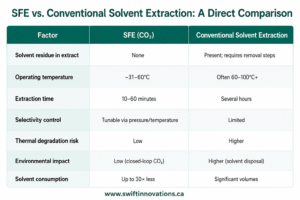
The selective nature of supercritical CO₂ is particularly valuable. By adjusting extraction parameters, operators can target specific compound classes, essential oils at one pressure, lipids at another, with a level of precision that liquid solvent systems cannot easily replicate.
Preserving What Matters: Thermal Sensitivity
Many of the most commercially valuable bioactive compounds, antioxidants, volatile aromatic compounds, heat-sensitive vitamins, and delicate phytochemicals are prone to degradation under high temperatures. Because SFE operates just above CO₂’s critical point (as low as 31°C), it preserves the integrity, potency, and biological activity of these compounds in ways that conventional high-temperature extraction cannot.
This matters directly to product quality. In pharmaceutical applications, for example, supercritical extraction’s ability to preserve the precise molecular structure and bioavailability of active ingredients is a key reason the pharmaceutical sector held 39.8% of the SFE market share in 2024.
Applications Across Industries

Cosmetics
The cosmetics industry increasingly demands natural, high-performance ingredients that align with clean beauty standards. SFE provides botanical oils, antioxidants, plant-derived actives, and functional skincare ingredients, all without solvent residues that could irritate skin or compromise formulation stability.
Nutraceuticals
In nutraceuticals, the quality and potency of bioactive compounds directly determine product efficacy. SFE’s low-temperature, residue-free process helps preserve the nutritional value of compounds used in dietary supplements, functional foods, and wellness products from omega-3 fatty acids to carotenoids and polyphenols.
Pharmaceuticals
Pharmaceutical applications demand the highest levels of purity, consistency, and precision. SFE meets these standards by producing extracts with minimal impurities and reliable compound profiles, supporting the development and formulation of active pharmaceutical ingredients. The pharmaceutical sector’s dominant share of the SFE market reflects this fit.
Upcycling Agricultural By-Products
One of SFE’s most strategically valuable capabilities is its ability to extract high-quality bioactives from materials that would otherwise be discarded. Agricultural residues, fruit peels, seed husks, and plant stems often contain significant concentrations of antioxidants, essential oils, and other bioactives, despite being considered waste by many.
With more than 5 billion tons of crop residues generated each year, and a large proportion going unused or burned in the field, SFE offers a meaningful opportunity to recover value from these streams. This positions SFE as a key tool for circular economy strategies in food, cosmetics, and pharmaceutical manufacturing.
A Technology Built for the Future
Sustainability is no longer a secondary consideration in ingredient manufacturing; it is increasingly a core commercial and regulatory requirement. SFE directly addresses this by reducing reliance on conventional solvents, minimizing waste generation, enabling CO₂ recycling, and supporting the productive use of agricultural by-products.
The market trajectory reflects this alignment. North America alone is projected to grow its SFE chemicals market at a CAGR of 10.9% through 2034, driven by consumer demand for clean-label products and increasing regulatory pressure toward greener extraction technologies across food, personal care, and pharmaceuticals.
As industries continue to prioritize sustainability, ingredient quality, and resource efficiency, Supercritical Fluid Extraction is well-positioned to become the standard, not the exception, in bioactive ingredient production.
At Swift Innovations, we believe technologies like Supercritical Fluid Extraction represent the future of sustainable ingredient development, combining scientific precision with environmental responsibility.