
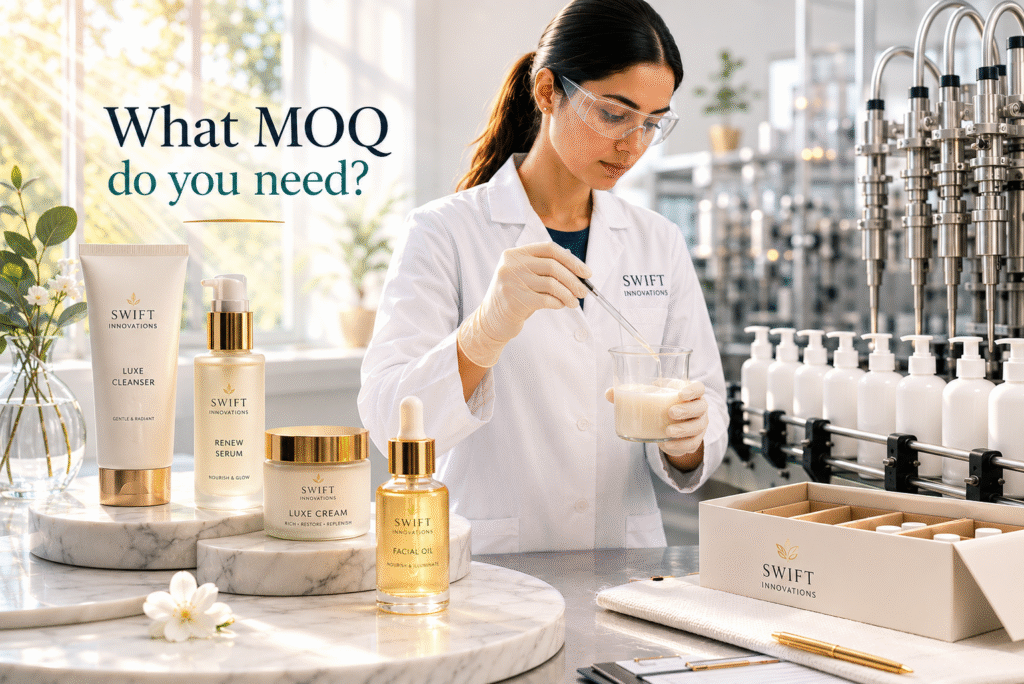
One of the first questions new skincare founders ask is: “What is the minimum order quantity (MOQ) for my product?”
The answer is often more complicated than a simple number.
In North America, skincare manufacturing MOQs can range anywhere from 100 units for certain private-label products to 5,000+ units for custom formulations and specialized packaging. The wide range often surprises first-time founders, many of whom focus only on formulation costs and overlook the impact of packaging, testing, and production requirements.
Many founders assume MOQ is simply a requirement imposed by manufacturers. In reality, MOQs are influenced by raw material sourcing, packaging supplier minimums, production efficiency, testing requirements, and overall project economics.
Understanding how MOQs work can help you budget properly, reduce risk, and make better decisions when launching your skincare brand. Whether you’re developing your first serum or planning a full product line, knowing what drives MOQ can help you avoid costly surprises and launch with greater confidence.
What MOQ Really Means in Cosmetic Manufacturing
MOQ Minimum Order Quantity isn’t just a number of units. It’s the lowest production volume at which a manufacturer can run your product efficiently, profitably, and without disrupting their line capacity.
Most people think MOQ means “the smallest number of bottles you can buy.” In reality, MOQ is the point where raw materials, packaging, labor, and equipment setup all align economically.
Why MOQs Exist ?
Every product requires a chain of commitments before a single unit is filled:
– Ingredients: Suppliers often have their own MOQs (e.g., 5 kg, 25 kg, 200 kg drums)
– Packaging: Bottles, pumps, caps, and cartons each have separate MOQs, often from different vendors
– Labels & Printing: Digital printing is flexible, but traditional printing has plate fees and minimum runs
– Testing: Stability, compatibility, and micro testing don’t scale down. The cost is fixed regardless of batch size
– Production Setup: Cleaning tanks, calibrating equipment, and allocating line time carry fixed labor and downtime costs
Because each component has its own minimum, the true MOQ is determined by the highest constraint in the supply chain, not just the number of units you want.
Simple Example : If your bottle supplier requires 1,000 bottles, your label printer requires 500 labels, and your formula requires a minimum 60 kg batch to run through the filling line
Then your MOQ isn’t 500 or 1,000 units, it’s whatever volume satisfies all three constraints simultaneously.
The Founder’s Insight :
MOQ is ultimately a business decision, not a manufacturing rule. It reflects:
- Cost efficiency
- Line utilization
- Supplier constraints
- Waste minimization
- Cash‑flow strategy
- Inventory risk
Understanding MOQ at this level helps founders negotiate smarter, plan launches more accurately, and avoid surprises in production timelines or cost per unit.
Why Do Manufacturers Have MOQs?
Manufacturers don’t set MOQs to make life harder for founders, they set them to keep production efficient, consistent, and economically viable. Even when a brand wants a small run, the manufacturer still has to complete the same amount of setup, labor, and compliance work behind the scenes.
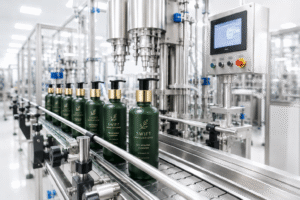
Production Setup
Before any batch begins, manufacturers must complete equipment cleaning, setup, calibration, and documentation. These steps take the same amount of time whether the batch is 100 units or 10,000 units, which is why very small runs become inefficient.
Raw Material Purchasing
Manufacturers often buy ingredients from suppliers who also impose their own MOQs. Specialty actives, botanical extracts, and preservative systems may only be available in multi‑kilogram quantities, even if the formula requires only a small amount.
Manufacturing Efficiency
Larger batches reduce labor hours, downtime, and material waste. This efficiency lowers the per‑unit cost, which is why manufacturers encourage higher quantities to keep pricing competitive.
The Hidden MOQs Most Founders Don’t Expect
Even if your manufacturer is flexible, other suppliers involved in your product launch may not be. These “hidden” MOQs often catch founders off guard because they come from packaging vendors, printers, and ingredient suppliers not the manufacturer itself.
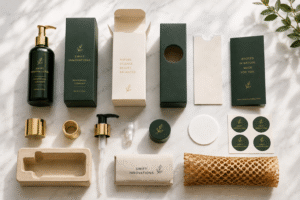
Packaging Components
A brand may only need 500 finished units, but packaging suppliers often require much larger minimums. Bottles, pumps, droppers, and labels commonly start at 2,500 – 5,000 units, creating excess inventory that must be stored and managed.
Printed Cartons
Custom boxes and printed cartons frequently have some of the highest MOQs in the entire project. Depending on size and printing method, suppliers may require 2,500–10,000 units per order.
Custom Ingredients
Trending or specialized ingredients like peptides, encapsulated actives, biotech ferments may only be sold in large bulk quantities. These supplier‑level MOQs can make small‑batch production challenging even when the manufacturer is willing.
Testing & Compliance Costs
While testing doesn’t have a “unit” MOQ, it does introduce fixed costs that function like one. Stability, compatibility, microbial, and preservative efficacy testing all add baseline expenses that founders must plan for regardless of batch size.
How to Reduce Risk When Starting a Skincare Brand
Start With Fewer SKUs
One excellent product is often better than launching five products simultaneously. Fewer products means:
- Lower inventory investment
- Simpler operations
- Easier marketing
Use Stock Packaging
Custom packaging often drives MOQ upward. Using stock bottles, jars, and closures can significantly reduce startup costs.
Consider Private Label Options
Private label products often have much lower MOQs because formulations and packaging systems are already established. This can be a smart way to validate market demand.
Validate Demand Before Scaling
Avoid producing thousands of units before proving market interest. Start small, gather feedback, and scale based on actual customer demand.
Why the Lowest MOQ Isn’t Always the Best Option
Many founders search for the manufacturer offering the lowest MOQ. However, focusing solely on MOQ can be misleading.
A very low MOQ may result in:
- Higher cost per unit
- Lower profit margins
- Limited packaging options
- Fewer customization opportunities
Sometimes producing slightly more inventory can significantly improve profitability.
Instead of asking: “What is the lowest MOQ?” Ask: “What production quantity makes the most financial sense?”
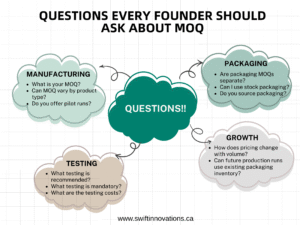
In Conclusion:
MOQ is one of the most important factors in determining how much capital you’ll need to launch your skincare brand. But MOQ alone doesn’t tell the whole story. Packaging requirements, testing costs, raw material sourcing, and manufacturing efficiency all play a role in determining the true cost of bringing a product to market. The most successful founders don’t simply look for the lowest MOQ they look for the right balance between investment, flexibility, product quality, and long-term growth.
How Swift Innovations Inc. Helps You Overcome The MOQ Barriers
At Swift Innovations, we partner with brands at every stage, from first‑time founders to established companies scaling their product lines. We understand that MOQ isn’t just a manufacturing constraint; it’s a strategic decision that shapes cash flow, inventory risk, and speed to market.
That’s why we offer smaller pilot batches and lower MOQs for select formulations. These controlled, lower‑volume runs allow founders to launch, test, and validate their products without taking on the financial burden of thousands of units upfront. It’s a practical way to reduce risk while still producing a market‑ready product that meets regulatory and quality standards.
Check out our post on: How to start a skincare line