
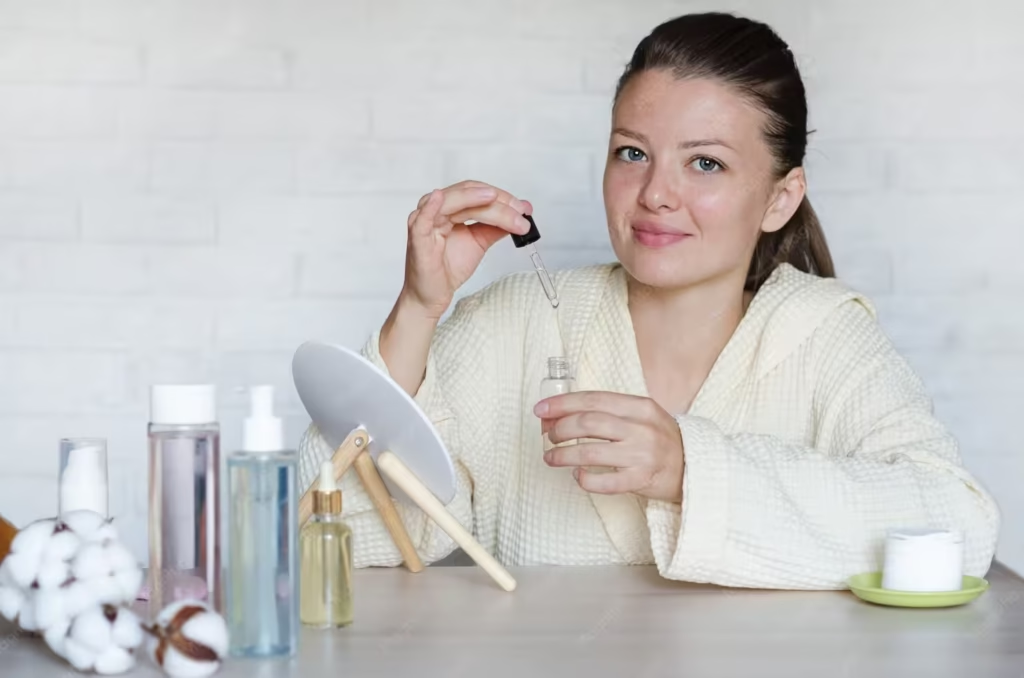
Peptides are short chains of amino acids – the same building blocks that make up the proteins in your skin — and in a well-made cosmetic formulation they act as messengers that tell skin cells to produce more collagen, repair tissue, or relax tension.
They aren’t a single ingredient with a single effect; they’re a category, and the three names you see most — GHK-Cu, Matrixyl and Argireline — do genuinely different jobs. As formulators, we work with these daily, so here’s the version without the marketing gloss.
Why peptides work at all
Your skin’s firmness comes largely from collagen and elastin, produced by cells called fibroblasts deep in the dermis. As those cells slow with age, skin loses structure. A correctly formulated peptide can penetrate the upper skin and signal those fibroblasts to get back to work — or, in the case of some peptides, tell overactive muscles to relax.
The key phrase is correctly formulated: peptides are sensitive to concentration, pH, delivery and what they’re paired with. A peptide on the ingredient list is not the same as a peptide that reaches its target.
The three that matter — and what each actually does
- GHK-Cu (copper tripeptide-1): A carrier and signal peptide with the broadest action. It modulates gene expression, supports collagen density, aids wound repair, and calms inflammation. Studied since the 1970s, a 2001 double-blind trial demonstrated firmness and wrinkle improvements comparable to retinoic acid but without the irritation.
- Matrixyl (palmitoyl pentapeptide-4): A signal peptide that instructs cells to synthesize collagen, elastin, and hyaluronic acid for targeted firmness and elasticity. It possesses some of the strongest clinical data available for cosmetic peptides.
- Argireline (acetyl hexapeptide-8): A neurotransmitter-inhibiting peptide that relaxes the micro-tension responsible for expression lines. This creates a gentle, topical “expression-softening” effect best suited for fine lines rather than deep structural wrinkles.
Note that these are three different mechanisms. GHK-Cu is a broad repair-and-signal peptide. Matrixyl is a focused collagen signal. Argireline works on muscle tension, not collagen at all. A serum that stacks them isn’t redundant — it’s covering three levers.
What founders get wrong about peptides
Three things we see constantly:
- Assuming more peptides = better. Above a certain concentration you get diminishing returns and rising cost. The right dose is a formulation decision, not a marketing one.
- Ignoring delivery. A peptide that sits on the skin’s surface does little. Delivery systems (we’ll come back to this in a future piece) determine whether it reaches the dermis.
- Bad pairings. Copper peptides and strong direct acids (like high-dose vitamin C) in the same layer can undermine each other. Sequencing and formulation matter.
The honest summary
If you’re building an anti-ageing product, GHK-Cu and Matrixyl carry the strongest evidence for firmness and repair; Argireline is a useful add for expression lines. But the peptide is only as good as the formula around it — the concentration, the pH, the delivery system, and the stability over the product’s shelf life. That’s the part that happens in the lab, not on the label — and it’s exactly the work our contract research team performs to ensure ingredient bioavailability.
Choosing the Right Cosmetic Contract Manufacturers in Canada for Scalable Growth
For many skincare brand founders, the journey from an indie prototype to a shelf-ready product is the most critical phase of business growth. You have refined your formula, selected your hero actives, and validated the concept with early customers. However, there is a distinct technical chasm between a stable, effective small-batch prototype and a mass-market production run. This is exactly where partnering with specialized cosmetic contract manufacturers in Canada—those with deep R&D and laboratory capabilities—becomes your brand’s greatest asset.
The Scale-Up Challenge: From Prototype to Production
A formula that performs beautifully in a 500ml beaker does not always behave the same way in a 500L homogenizer. Scaling up introduces new physical and chemical variables that can destabilize a product if the underlying science isn't accounted for. Issues like shear stress, heat transfer, and mixing speed can fundamentally change the performance of high-end bioactives, emulsions, and surfactants. When a product fails during scale-up, it is rarely because of the actives themselves; it is usually a breakdown in the stabilization system. Without proper pre-production R&D, brands often face phase separation, unexpected viscosity fluctuations, or the degradation of sensitive ingredients like peptides or botanical extracts.
The Importance of Technical R&D in Private Label Skincare
Effective contract manufacturing is rarely just about bottling liquid; it is about engineering. Before a production run begins, an experienced formulation partner performs critical pre-production R&D to ensure the product remains consistent at scale. This stage involves a thorough formulation audit, where experts review the feasibility of the current emulsification process and ensure that heat-sensitive bioactives are added at the appropriate phase to maintain potency.
By involving a team with deep expertise in private label skincare formulation early in the process, brands can avoid expensive recalls and negative consumer feedback.
Ensuring Quality: Stability and Rheological Testing
Scaling is also a rigorous test of performance. As a brand, you need to be certain that your product will maintain its shelf life, texture, and active efficacy from the moment it is manufactured until the consumer uses it six months later. A science-first manufacturing partner prioritizes stability testing to determine how temperature fluctuations impact the product structure, and rheological analysis to measure viscosity and flow, ensuring consistent texture whether the product is pumped, squeezed, or scooped.
Why Your Brand Needs a Science-First Manufacturing Partner
In the beauty industry, there is a clear distinction between a “manufacturer” and a “formulation partner.” A manufacturer will produce what is on the page, but a formulation partner will question, optimize, and validate it. When searching for the right partner, brands should look for facilities that offer on-site lab capabilities for faster troubleshooting, regulatory proficiency to navigate Health Canada guidelines, and access to advanced research in fields like nanoencapsulation or peptide synthesis.
Your ingredients are the foundation of your success, but your manufacturing process is the structure. To build a brand that is truly backed by science, you must treat manufacturing as an extension of your R&D efforts. By choosing a partner equipped with advanced scientific infrastructure and a commitment to technical precision, you are investing in the long-term viability of your brand.
Are you ready to move your formula from the lab to the market? Contact the Swift Innovations team to discuss how our R&D and manufacturing capabilities can support your brand’s next phase of growth.
Frequently Asked Questions
What do peptides do in skincare?
Peptides are short amino-acid chains that signal skin cells to produce more collagen, repair tissue, or relax muscle tension — supporting firmer, smoother skin when properly formulated.
Does GHK-Cu (copper peptide) actually work?
It has some of the broadest evidence of any cosmetic peptide. A 2001 double-blind trial found firmness and wrinkle improvements comparable to retinoic acid, with far less irritation. It supports collagen and skin repair.
What’s the difference between Matrixyl and Argireline?
Matrixyl signals collagen and elastin production for firmness. Argireline relaxes the micro-tension behind expression lines. They target different mechanisms, so they’re often used together.
Are more peptides in a product always better?
No. Beyond an effective concentration you get diminishing returns and higher cost. Effectiveness depends on dose, pH, delivery system and pairings — not the number of peptides listed.