The Skincare Market Is Saturated. So Why Do New Brands Still Succeed?
Every year, thousands of entrepreneurs launch skincare brands. Some build loyal followings. Many quietly disappear.
One question sits at the center of that difference: “If customers already have so many choices, why would they choose another brand?”
The global skincare market is worth well over US$150 billion, and continues to grow. New cleansers, serums, moisturizers, and treatments appear almost every week, often using similar ingredients, and claims targeting similar concerns.
I have seen crowded categories produce strong new brands. I have also seen well-funded products fail because there was no clear customer need behind them.
The market is crowded. But crowded does not always mean closed.
Consumers Are More Willing to Switch
Years ago, consumers tended to stay loyal to a handful of trusted brands. Today, discovery is constant. Social media, influencers, reviews, clinics, and retailers expose people to new products every day.
Consumers still have favorites, but they’re far more willing to experiment.
That creates both opportunity and pressure. New brands can gain attention quickly, but they can lose it just as fast.
The First Sale and the Second Sale Are Different
Founders who already run salons, clinics, spas, or wellness businesses often have an advantage: trust.

Their existing customers may buy a new product out of loyalty or curiosity. The first batch may sell quickly. But this can be misleading.
This is why early sales are not enough to validate a brand.
Reorders, retention, and unsolicited feedback matter more than launch excitement.
Customer trust earns the first sale. Product performance earns the second.
You Do Not Need a Completely New Idea
Many founders believe they must invent something entirely new to succeed.
Successful brands rarely create entirely new categories. More often, they improve existing ones.
Differentiation does not always come from invention. It often comes from refinement.
A customer who enjoys luxury skincare may still look for a more accessible version of the same experience. Another may want fewer steps, clearer instructions, or better ingredient transparency.
Better execution is often more powerful than novelty.
Changing Expectations Create New Openings
Consumer expectations continue to evolve as they are paying closer attention to fragrance, allergens, sourcing, sustainability, and ingredient transparency, while scientific advances and regulatory standards keep raising the bar.
Some respond with cleaner formulations and greater transparency, while others differentiate through formulation technologies such as encapsulation or microemulsion systems to enhance product performance. These approaches do not guarantee success, but they can create meaningful differentiation.
A Good Idea Can Still Arrive Too Early
Not every strong idea is ready for the market.
Sometimes the product is ahead of consumer understanding. Sometimes the category requires too much education. Sometimes the price feels unjustified because the benefit is not yet obvious.
Being early can be as challenging as being wrong.
A well-timed average idea often outperforms a brilliant idea that arrives too early.
Founders Often Fall in Love With the Work
Founders see months of development, testing, and iteration.
Customers see a product in seconds.
That difference matters. A founder may care deeply about a formulation detail that the customer may never notice.
This is also why retention matters so much. Acquiring a new customer is typically 5–7 times more expensive than retaining an existing one. Yet founders frequently focus most of their energy on winning the next customer, when the bigger opportunity may be giving the first customer a reason to return.
Trying to Solve Everything Weakens the Product
First-time products often try to do too much, hydrate, brighten, calm, treat acne, reduce aging, and suit everyone.
That creates confusion. Customers respond better to products with a clear purpose and a defined audience. A product that tries to serve everyone often connects with no one.
Friends and Loyal Customers Are Not the Market
Early feedback is encouraging but often misleading.
Friends, family, and loyal customers want the founder to succeed.
Better validation comes from behavior:
• Will they pay full price?
• Choose it over competitors?
• Buy it again?
• Recommend it without being asked?
Those answers matter more than encouragement.
Validate Before You Scale
Many founders scale too early.
They invest in multiple SKUs, custom packaging, and large inventory before confirming demand.
A more controlled approach reduces risk:
- Launch one hero product first
- Use simpler packaging initially
- Start with proven bases where appropriate
- Test with real customers before scaling production
Validation does not remove risk but it prevents avoidable failure.
The Formula Is Not the Entire Brand
Founders often focus heavily on formulation.
But customers experience the entire system:
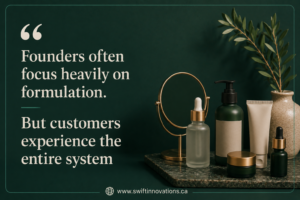
Packaging, usability, price, education, trust, service, and brand story all matter.
A strong formula supports retention.
A strong brand drives acquisition.
Both are required for long-term success.
So, Is It Worth Launching?
Launching a new product is difficult.
Across consumer packaged goods (including beauty and personal care), Nielsen found that approximately 76% of new product launches failed to remain in the market after their first year.
In beauty and personal care, competition and repeat-purchase dependency make retention especially critical.
But failure is not always about saturation.
It is often about:
- unclear positioning
- weak differentiation
- poor timing
- overcomplicated development
- lack of real customer validation
I do not believe the skincare market is saturated with solutions.
I believe it is saturated with products.
There is a difference!
The real question is not:
“Is there room for another skincare brand?”
It is:
“Will customers choose this again after the first purchase?”
That is where a product begins to prove its value.